The wagon is still under a cover. The engine is still the problem. But while I've been stuck in diagnosis mode, I've been doing what I can do from a distance: researching what this car is supposed to look like when it's actually finished.
Whitewalls are part of that picture. And I recently found out they're not just a style choice I'm imposing on the car. They were a factory option.
The photo
This is my grandpa in his 1985 Chrysler Town & Country, straight from the dealer.
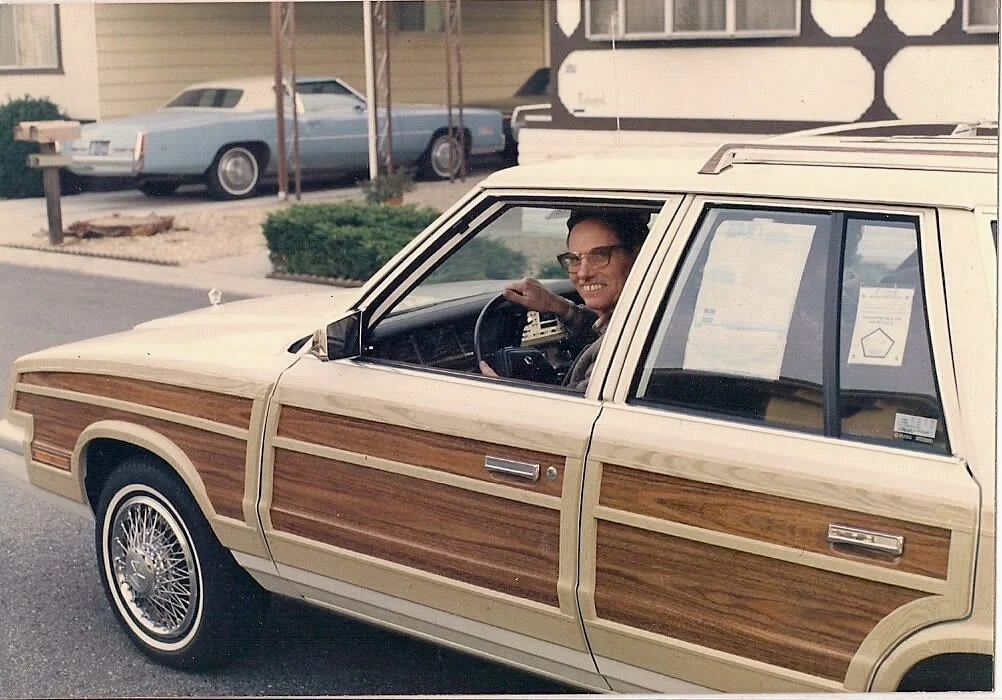
Same year. Same model. Whitewalls on wire spoke wheels, dealer-delivered. That's not an aftermarket add-on or a vintage photo trick. That's what Chrysler was putting on these cars when they left the lot in 1985. The whitewall was a real option you could tick at the dealership.
That settles one question I'd been sitting on. Now the more useful questions: what kind of whitewalls, and what do they actually cost?
What the photo tells us
Look at the whitewall width in that picture. It's not a wide, dramatic stripe. It's relatively narrow, maybe an inch to an inch and a half at most. That matters when shopping, because wider isn't automatically more correct. If the goal is factory-accurate, the width you're chasing is closer to what's in that photo than the 2.25-inch bands that show up on a lot of the classic tire options.
The wheels in the photo are also wire spokes, and from what I can tell, the wagon I have uses the same style. Wire spoke wheels often run a different rim width than standard steel wheels, which affects tire fitment. Before ordering anything, that rim width needs to be confirmed. Most of the tires I've been looking at recommend a 5 to 6.5-inch rim width. If the wire spokes fall outside that range, it changes the conversation.
Two ways a whitewall tire is actually made
Here's something that took me a while to understand, and that nobody really explains upfront: not all whitewall tires are built the same way. There are two fundamentally different manufacturing approaches, and they're worth knowing before spending any money.
The first is what's called a true integrated whitewall. This goes back to how whitewalls were invented in the first place. Early tires were made of natural rubber, which is off-white. When carbon black was added to the tread compound to improve durability, manufacturers initially only applied it to the tread surface. That left the sidewall its natural color. The first whitewall was basically an accident. Eventually it became deliberate, and manufacturers started building a dedicated strip of white rubber into the tire's carcass during original construction, vulcanized in from the start. The white rubber isn't sitting on top of anything. It's fused into the tire. It won't chip, peel, or separate because it's structurally part of the tire.
The second approach is what Diamond Back Classics does, and it's worth understanding because it's not what I initially assumed. Diamond Back starts with a finished modern blackwall tire and adds the whitewall as the final manufacturing step. From their own description: they mount the tire on a spinning machine, rough up the sidewall, and use a chemical-and-heat vulcanization process to permanently bond white rubber to it, the same process used to build the tire originally. It's not paint and it's not an adhesive strip. The white rubber becomes molecularly bonded to the sidewall. The key difference from a true integrated whitewall is sequencing: one has the white rubber built in from the start, the other has it added at the end using the same bonding technology.
What the Diamond Back approach trades in manufacturing purity, it gains in flexibility. Because the whitewall is applied after the fact, they can offer it in sizes that no specialty tire manufacturer would ever tool up to produce from scratch, including P185/70R14, the factory size for this car.
The actual options in P185/70R14
The factory tire size on a 1985 Town & Country is P185/70R14. That's confirmed across multiple spec sources. Here's what's available in that size with whitewalls.
Tier 1: True integrated whitewall
The whitewall is built into the tire from the start. DOT approved, made in the USA, backed by a life-of-tread warranty, in stock. Coker's fitment chart specifically lists the 1982-88 Chrysler Town & Country Wagon as original equipment with this size, so it's confirmed correct, not just close. The one caveat for factory accuracy: at 2.25 inches, the whitewall is wider than what appears in the photo of grandpa's car. If narrower is more correct, this may not be the right width.
Tier 2: Vulcanized-after whitewall
Built on a Nexen radial carcass with Diamond Back's vulcanization process. The significant advantage here is whitewall width flexibility. Options run from 2 inches down to narrower profiles, which means you can get closer to the factory look in the photo. Built to order with a 3 to 6 week lead time. One thing worth a direct call to them before ordering: their tires are technically labeled for pre-1976 vehicles due to a sidewall labeling requirement, and it's worth confirming whether that creates any practical issue for a 1985 car.
A quick comparison
| BFGoodrich Silvertown | Diamond Back I | |
|---|---|---|
| Price per tire | $337 | $279 |
| Set of four | ~$1,348 | ~$1,116 |
| Construction | Integrated from build | Vulcanized after build |
| Whitewall width | 2.25 inch (fixed) | Chooseable |
| Size confirmed for this car | Yes, on Coker fitment chart | Yes, listed in catalog |
| Lead time | In stock | 3 to 6 weeks |
| Made in USA | Yes | Nexen carcass, US-finished |
What I'd actually do
The honest answer is that the Diamond Back I is probably the more interesting option for this specific car, for one reason: width control. If grandpa's photo is the target, a narrow factory-style whitewall on wire spoke wheels, the ability to dial in the width matters more than which manufacturing tier the tire comes from. The BFGoodrich Silvertown is the more traditional answer, but its 2.25-inch whitewall may be wider than what's actually correct here.
Before either of these becomes a real purchase, two things need to happen: the engine gets sorted, and the wire spoke rim width gets measured. Neither of those has happened yet. But at least now I know what I'm shopping for, and I have a photo of what it's supposed to look like.