
Survival Guide
1985 Town & Country Turbo: the survival guide.
Everything I wish someone had told me before I bought one of Chrysler's strangest fake-wood turbo wagons: the failure points, the diagnostics, and the parts hunt.
Quick Answers
The five questions everyone asks first.
Short answers here: the rest of the guide covers the systems, the evidence, and the repair stories behind them. Every tag marks where a claim comes from: a factory or period source, a specialist reference, something I observed on this wagon, a diagnosis in progress, or a factory system note.
Factory System
Is the Chrysler 2.2 Turbo reliable?
It can be, when the cooling, oiling, fuel, ignition, and vacuum systems are all healthy. More often the real problem is age: neglected hoses, overheating, tired wiring, and previous repairs done wrong. Judge a forty-year-old example by its condition and test results, not its reputation.
Common Trouble Areas
What problems should an owner expect?
Cooling-system faults, vacuum or boost leaks, aging electrical connections, fuel-delivery trouble, and oil or PCV leaks: roughly in that order. The 1985 engine controls also run on separate logic and power modules, so advice written for later Chrysler computers doesn't always carry over.
Safety First
What should I check before driving one?
Cold coolant level and leaks, engine oil, fuel leaks, belts, hoses, tires, brakes, charging voltage, and any stored fault codes. Do not drive it if it overheats, rapidly loses coolant, leaks fuel, loses oil pressure, or has unsafe brakes or steering.
Parts Reality
Can you still find parts for a 2.2 Turbo?
Most maintenance items and shared K-car parts are easy enough to find. Turbo-specific electronics, trim, wagon body parts, and anything calibration-sensitive are the hard part. Write down your original part numbers, and confirm the exact year, engine, emissions setup, and connector before you order anything.
Built-In Diagnostics
Can I diagnose one without a modern scan tool?
Yes. A lot of the first checks just need ordinary tools and the car's built-in lamp-flash fault codes: no OBD-II scanner required on this early system. A code points you to a circuit or operating problem worth testing. It does not automatically mean a bad part.
Start Here
So you found one of these things.
The 1985 Chrysler Town & Country Turbo wagon is not a normal project car. It is part family wagon, part fake-wood time capsule, part turbo Mopar oddity, and part mechanical group project with everyone who owned it before you.
This guide is not written from the perspective of an expert. It is written from the perspective of someone learning while trying to save one.
That means this page is practical, honest, and built on everything that has already gone wrong on my own wagon.
This is not the official manual. It is the "what I wish I understood before crawling under the dash" version. General 2.2 Turbo advice and evidence from my own wagon are labeled separately, because one old Chrysler's problem is not automatically every old Chrysler's problem.
Engine & Drivability
The 2.2 Turbo makes things interesting.
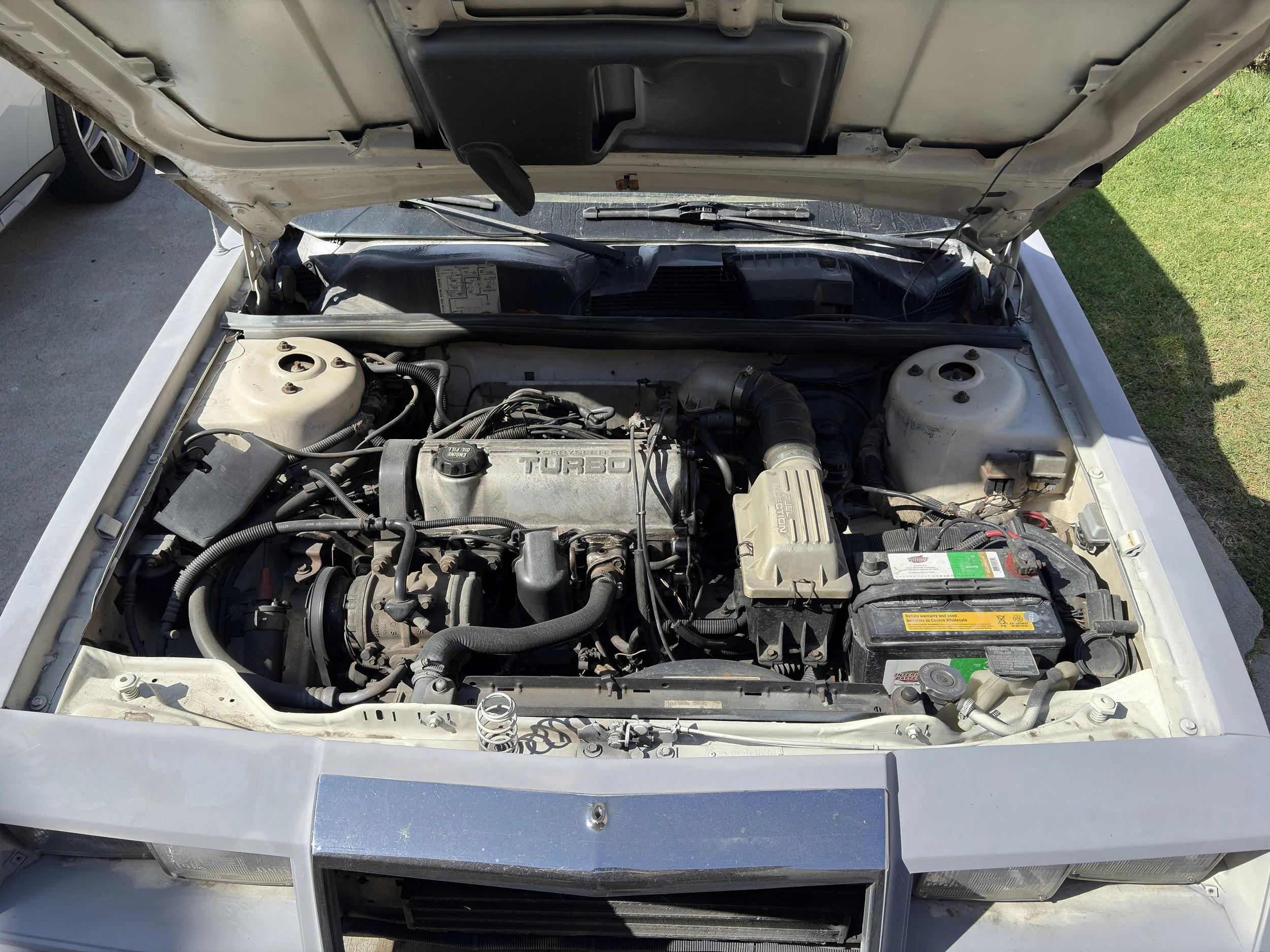
The turbo 2.2 is half the reason this wagon is cool, and half the reason the engine bay looks like a museum of vacuum lines, sensors, hoses, mystery routing, and previous-owner creativity.
Cooling System
Overheating is the big scary one.
Cooling problems are one of the biggest reasons my wagon is not road-ready. On an old turbo car, I would rather be slow and careful than cook the engine because I got impatient.
Warning
General diagnostic sequence.
Start with a cold engine and inspect the coolant level, radiator cap and neck, recovery hose, radiator, hoses, clamps, fan operation, thermostat installation, belt condition, and obvious leaks. Pressure testing and combustion-gas testing can reveal more, but coolant pushed from the radiator neck does not prove a failed head gasket by itself.
Observed On This Wagon
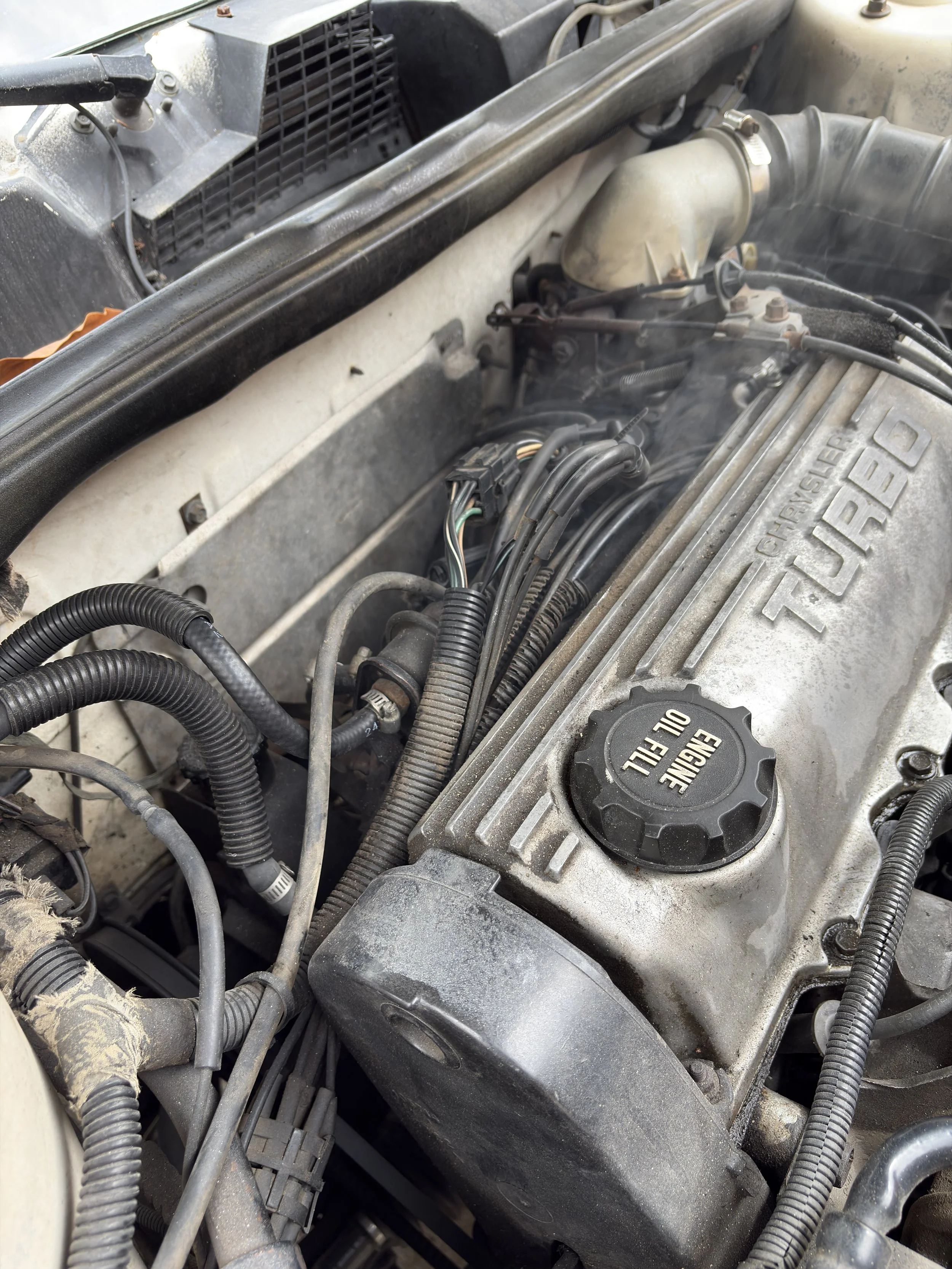
Confirmed: cylinder #1 has a major compression problem.
Likely: the head gasket or cylinder head is involved.
Still unknown: the exact failed part, where pressure is escaping, and whether the cylinder head is warped or cracked.
My wagon's #1 cylinder: 61 psi with the radiator cap installed and 61 psi with it removed. Cylinders #2, #3, and #4: 140 psi each. Other evidence: clear liquid on the firing tip of plug #1 and coolant surging from the radiator neck.
Current status: paused and not roadworthy. The engine will not be run again while the cause remains unresolved.
BWG Diagnosis Video
Three cylinders had 140 psi. One had 61.
The video connects the compression results to the wet #1 spark plug, overheating, coolant surge, and the reason the project is currently paused.
Sources & Method
What this guide is based on.
Factory information controls specifications and procedures. Specialist archives help explain early Chrysler systems and parts realities. The BWG repair pages document observations from this specific wagon. Sources were reviewed August 13, 2026.
Operation CHARM
1985 Chrysler 2.2L Turbo VIN E provides year- and engine-specific repair and diagnostic material for the shared Turbo I system.
Visit Operation CHARM →Chrysler Master Tech Turbo EFI
Drivability training explains how Chrysler's early turbo fuel-injection and engine-control systems work.
Watch The Training →MiniMopar's Chrysler ECU Guide
Documents the separate logic module and power module used on 1984 through 1987 fuel-injected Chrysler four-cylinder systems.
Read The ECU Guide →Turbo Dodge Parts Diagrams
Vacuum and boost diagrams include distinct 1985 Turbo I diagrams and separate Federal, California, and Canadian configurations.
See The Diagrams →LAPL ChiltonLibrary
Los Angeles Public Library's ChiltonLibrary provides repair information for checking procedures and specifications against a recognized service reference.
Visit ChiltonLibrary →The BWG Repair Pages
The low-compression diagnosis, compression test, and spark-plug inspection document what was actually observed and measured on this wagon.
Read The Diagnosis →This page is educational, not a substitute for the correct factory procedure. Configuration-sensitive details still need to be matched to the vehicle's underhood emissions label, original part numbers, and physical components.
Electrical & Dash
The dash is a whole adventure.
Old Chrysler dashboards are full of fragile plastic, strange access angles, tiny bulbs, questionable previous work, and wiring harnesses that may or may not be connected when you find them.
Interior
The inside is where small wins feel big.
Interior work matters because it changes how the wagon feels immediately. The engine might still have questions, but at least the headliner no longer looks like it is trying to become a blanket.
No yanking. No forcing. No "I bet this will flex." It probably will not.
Suspension
Trying to make it less boat-like.
The wagon rides like an old wagon, which is charming until it becomes unclear whether the charm is actually worn-out suspension.
The goal is not performance. The goal is comfortable, predictable, safe, and slightly less floaty.
Paint & Body
The previous paint job is now my problem.
The wagon came with heavy orange peel, mystery roof bondo, primer burn-through, and a lot of evidence that somebody else already had a very long afternoon with this car.
Sometimes I am fixing the wagon. Sometimes I am fixing the last repair.
Parts & Resources
Finding parts is part of the project.
The hardest part is not always the repair. Sometimes it is figuring out what part fits, whether anyone still sells it, and whether the listing is actually for the right version of the car.
What I Know So Far
The survival rules.
Do not assume the previous repair was done correctly.
Photograph everything before taking it apart.
Old plastic is not flexible. It is waiting to betray you.
Vacuum lines deserve labels, patience, and emotional support.
Cooling issues get respect. No hero driving.
Research counts as progress when the alternative is buying the wrong parts.
If something feels rigged, it probably has a story.
Sometimes the repair is figuring out why the repair is not working.
Still Learning
Still learning. Still fixing.
This guide will keep growing as the wagon keeps revealing new problems, old repairs, and tiny victories.